Grading & Assessment at AIM
At the Academy for Innovation in Medicine (AIM), grading and assessment are designed to provide students, families, and teachers with meaningful information about what students know, what they can do, and what they are ready to learn next.
AIM uses a mastery-based grading system. Our goal is for a student's grade to be the most accurate reflection of mastery of course standards, competencies, and learning objectives, rather than a measure of task completion, compliance, or behavior. Grading is intended to help students understand their progress, identify next steps for growth, and build the independence they will need in college, healthcare careers, and life.
Our Grading Philosophy
AIM's grading system is grounded in four commitments:
Accuracy: Grades communicate mastery of standards, not points collected.
Clarity: Students and families should understand what is being measured and how mastery is determined.
Growth Over Time: Students have multiple meaningful opportunities to demonstrate learning, with the most recent and most consistent evidence carrying the greatest weight.
Consistency and Equity: Grading is standards-aligned and applied consistently across teachers and courses.
The AIM Proficiency Scale
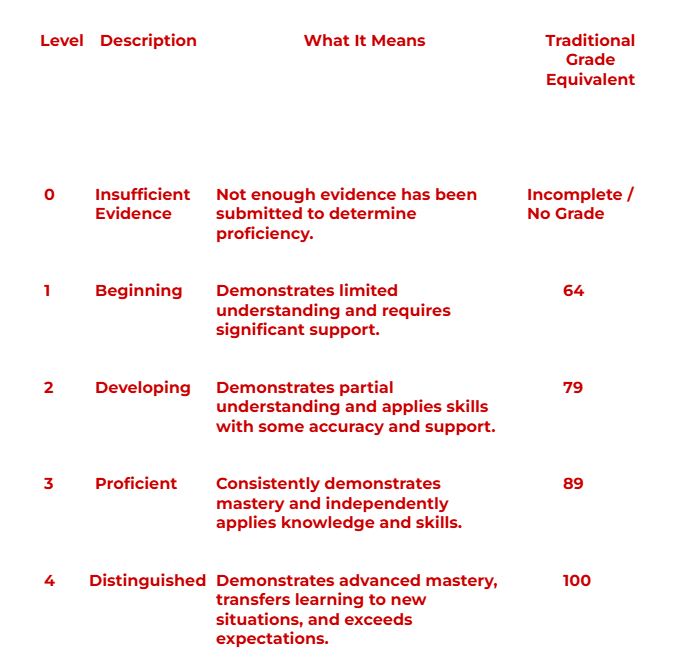
Student work is evaluated using AIM's four-level proficiency scale.
A Level 0 is reported as Incomplete / No Grade rather than a zero. This signals that additional evidence of learning is still needed without mathematically penalizing a student with a zero on a 100-point scale. At the end of the semester, proficiency scores are converted to the traditional 100-point scale for final course grades.
Formative and Summative Assessment
AIM distinguishes between practice and evidence of mastery.
Formative assessments are opportunities to learn, practice, receive feedback, and improve. They may include daily work, drafts, check-ins, low-stakes quizzes, and other learning activities. Formative work may be recorded for progress-monitoring purposes but does not determine a student's course grade.
Summative assessments provide evidence of mastery. They may include projects, performance tasks, presentations, simulations, laboratory experiences, exams, and industry-aligned assessments. Summative evidence is used to determine proficiency and course grades.
Opportunities to Demonstrate Growth
AIM believes students should have meaningful opportunities to improve after receiving feedback.
Students may participate in reteaching, test corrections, mastery activities, redos, or retakes before demonstrating learning again. Retake assessments measure the same standards using different questions or tasks. Teachers communicate the timeframe and expectations for redos and retakes to students and families.
Late work is accepted within a clearly communicated course window without an automatic grade penalty. If sufficient evidence is not submitted, the student receives an Insufficient Evidence designation rather than a zero.
Grades Reflect What Students Know
AIM does not simply average every score a student receives on a standard. When a skill or standard is assessed multiple times, teachers prioritize the student's most recent and most consistent evidence of mastery. This allows grades to reflect student growth rather than permanently weighting early struggles against later achievement.
Academic grades are also kept separate from behavior, attendance, and learner habits. These areas are important and may be communicated separately, but they do not distort the academic grade itself.
Common Assessments
Where multiple teachers teach the same course or grade level, AIM uses common standards-aligned summative assessments. Teachers collaborate to develop and calibrate assessments and scoring practices so that the same level of mastery represents the same level of achievement across classrooms.
NWEA MAP Growth
In addition to classroom assessments, AIM uses NWEA MAP Growth as a nationally normed assessment to better understand each student's academic achievement and growth.
MAP Growth is an adaptive assessment, meaning the difficulty of questions changes based on a student's responses. This allows the assessment to provide information about a student's instructional level, including students who are performing above or below grade-level expectations.
AIM uses MAP Growth results to:
Identify academic strengths and areas for growth
Measure student growth over time
Inform differentiated and individualized instruction
Help identify students who may need intervention or additional academic challenge
Establish instructional priorities for teachers and student support teams
Help students understand and monitor their own academic growth
MAP Growth is one source of information about student learning and is considered alongside classroom performance, common assessments, teacher observations, and other academic data.
Georgia Department of Education Assessment System
As a Georgia public charter school, AIM participates in the Georgia statewide accountability and assessment system.
The purpose of the Georgia Student Assessment Program is to measure student achievement of state-adopted academic standards and provide information that can be used to improve teaching and learning. Assessment results help schools identify students who have not yet demonstrated mastery of content, provide educators with information about instructional effectiveness, and identify schoolwide strengths and areas for improvement.
State assessment results represent one component of AIM's broader assessment system and are considered alongside classroom evidence, MAP Growth data, common assessments, student work, and other measures of student progress.
Georgia Milestones Assessment System
The Georgia Milestones Assessment System is Georgia's standards-based summative assessment program.
Depending on a student's grade level and enrolled courses, Georgia Milestones assessments may include:
End-of-Grade Assessments (EOG) for students in middle school grades.
End-of-Course Assessments (EOC) for students enrolled in designated high school courses.
AIM administers Georgia Milestones assessments according to Georgia Department of Education requirements, schedules, and testing procedures.
Learn more about the Georgia Milestones Assessment System
ACCESS for ELLs
ACCESS for ELLs is administered annually to students identified as English Learners.
The assessment measures students' development of academic English language proficiency in the areas of listening, speaking, reading, and writing. Results help AIM monitor English language development and inform appropriate instructional supports and services.
Georgia Alternate Assessment
The Georgia Alternate Assessment (GAA) is available for students with the most significant cognitive disabilities who meet state eligibility requirements.
Participation in the GAA is determined individually in accordance with applicable state requirements and, when appropriate, through the student's Individualized Education Program team.
Using Assessment to Support Students
At AIM, assessment is not simply about producing a score.
Teachers and school leaders use assessment information to answer important instructional questions:
What has the student mastered?
Where are there gaps in understanding?
What should the student learn next?
Does the student need additional intervention or enrichment?
Is the student demonstrating adequate growth over time?
This approach supports AIM's commitment to individualized pathways and competency-based learning. Assessment allows us to respond to the needs of each learner while maintaining rigorous expectations for all students.
Communicating Student Progress
AIM is committed to ensuring that students and families understand how academic progress is measured. The school provides information about proficiency levels, course competencies, assessment results, retake opportunities, and final grades in family-friendly language and works to ensure that grading expectations remain clear and consistent. Parents may access the gradebook in Infinite Campus.